Friday, March 20, 2015

TJ: Mini-Sea: #11

Aquarium Status

21/03/2015

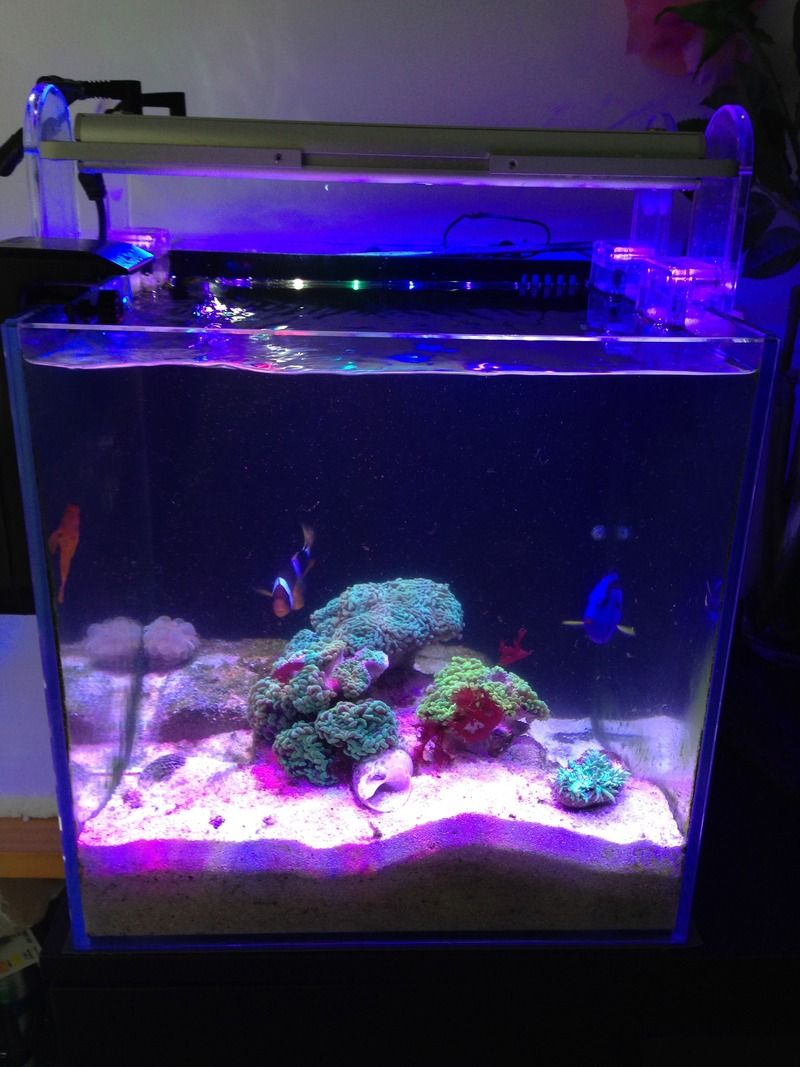
It's been a while! So after losing my Tomato Clownfish almost two weeks ago, I was really bummed out. But hey, gotta move on.

I have yet to decide what else to stock the aquarium with, and my fiancee and I have decided that we are moving houses early July - so it is a bit pointless to be fully invested at the moment. Especially since I am still injured.

This doesn't mean that I have given up on this tank. Au contraire, it is still a mini-reef, so I am still gonna sustain it.

So, update.

I've been letting algae run a bit rampant, as I didn't have a chance to do a water change until today. Besides cleaning the viewing panes, cleaning algae otherwise is rather pointless, as unless it is physically removed from the water, the algae would just float around and either re-attach, or die and feed more algae anyways. So the best time to clean algae is just before a water change. Especially if it is a large one.

I did an approximately 85% water change yesterday. The live stock is healthy, so I didn't mind doing such a large water change. Plus, I haven't done a water change for about a month, so it was time.

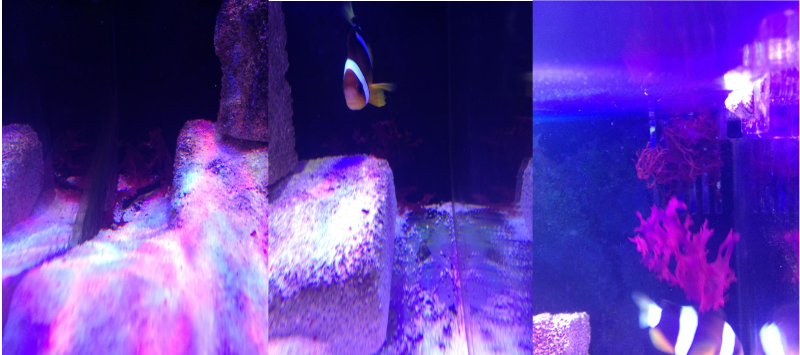
This is what the aquarium looked like before the water change:


Algae everywhere. Look at the colors of those corals tho!

Yes I know. SO MUCH ALGAE. Since I couldn't do a water change until yesterday, there wasn't actually much point in cleaning the algae, except of course the viewing panels - which quickly saw regrowths anyways.

Not that algae is that bad. XD People often have this misconception, but algae can only harm something else directly through one method: competition. Either for nutrients, lighting, space or whatever else. Otherwise, they are harmless. Good even, as they soak up excess nutrients, those that at elevated levels will harm stuff like corals. By the way, if you wonder why you'd clean the tank and algae springs right back, that would be because you did not remove the algae from the aquarium. Algae off the glass will come back rather quickly.

Sorry about the digression.

But yes, so much algae.

Check out my hand after I scrubbed all the sides off algae:


Some call it... 'hair' algae.

And that's just a tiny portion, stuck to my hands lol.

Anyways, with all the algae floating in the aquarium, I went ahead and did a water change with my hose-pump thing, draining out as much of it as possible along with the water.

Result?


You can still see some algae floating around - that was because I did leave some water behind, for the fish at least. They panicked a bit at first, but quickly regained their composure - fast enough to not see any panic by the time I could take this picture, like a minute after filling up the tank. If your fish are healthy and active, they should not mind such changes. Use that as an indication for how well you are caring for your fish (besides the occasional panic-inducing huge water change lol).

Corals too, will bounce back quickly if they are healthy. The above pic sees the corals all shrunk (except for the Bubble Coral towards the back).

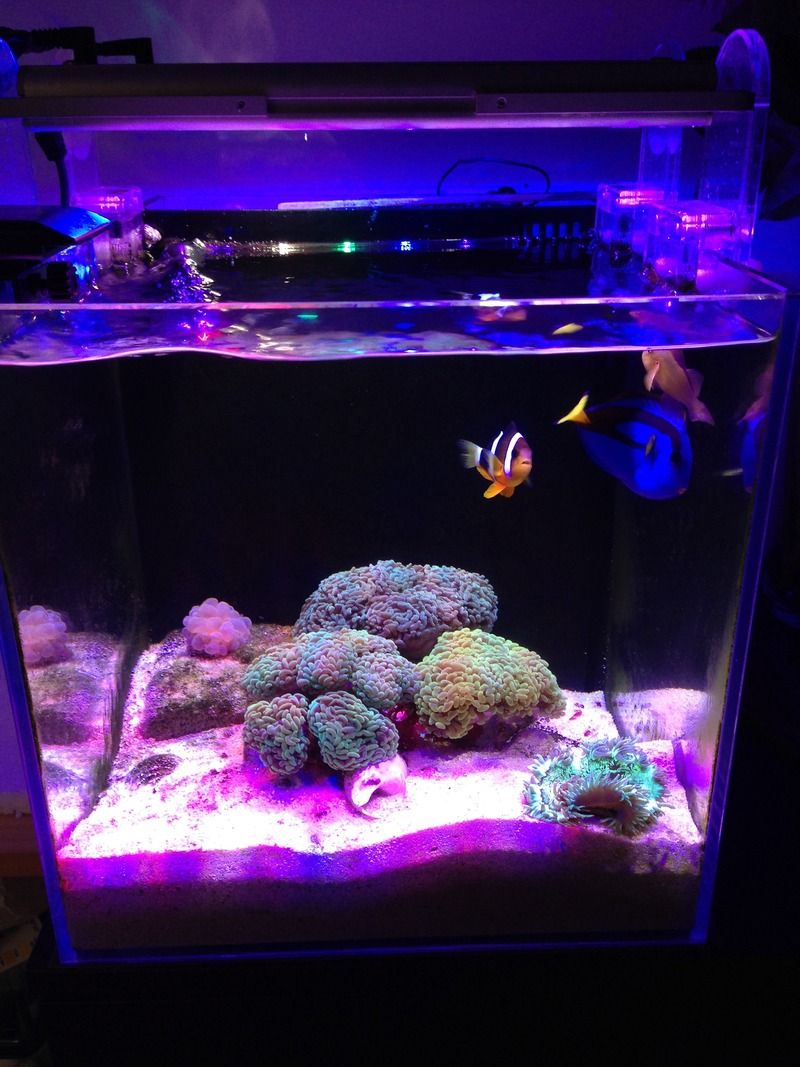
This is how they look at night, a few hours later:


All the fish are congregating towards one corner. Begging for food as the usual. =.= Pigs.

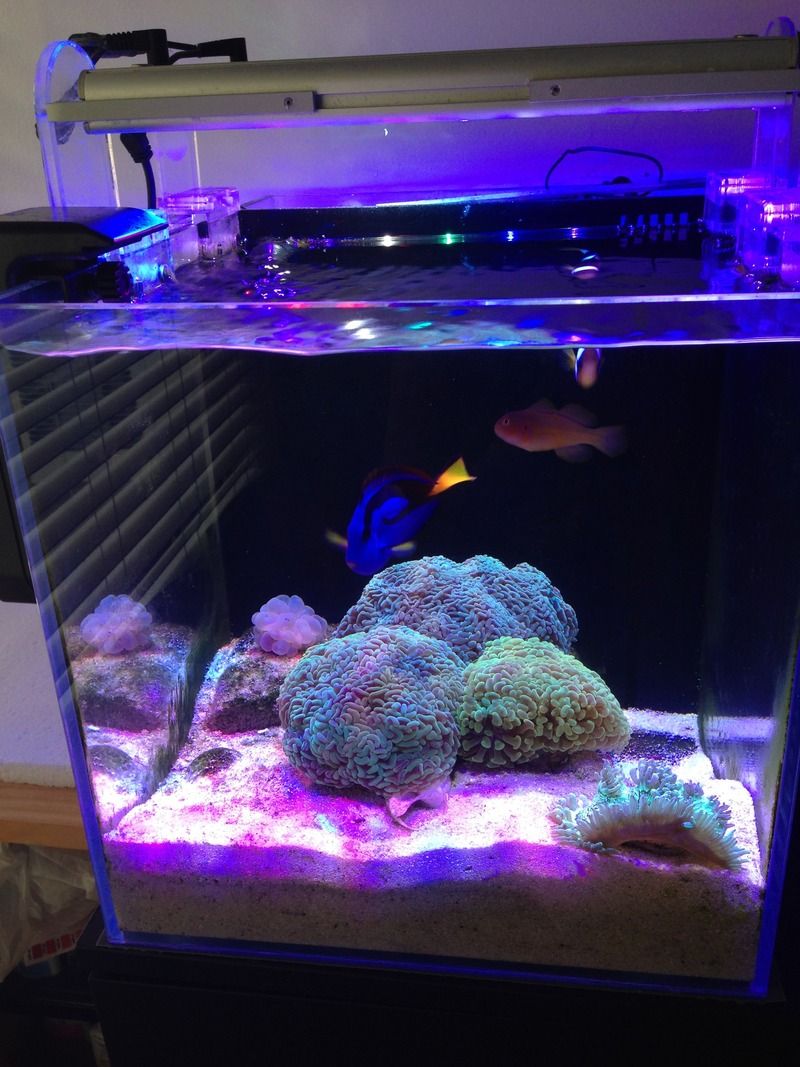
And then today, less than 24 hours later:


Bloomin'!

So in conclusion, everything is going great. :D And if you want to really remove a lot of algae and prevent it from growing back quickly, give your aquarium a good clean just before doing a water change to remove all that algae.

Sunday, March 8, 2015

TJ: Mini-Sea: #10

Aquarium Status

08/03/2015

Happy International Woman's Day.

Anyways my Tomato Clown jumped out whilst I was away over the weekend, either yesterday or today.

Never getting a topless tank again.

Short update but $@%$!@%!.

Friday, February 27, 2015

Marine Aquarium Sizes and What They Mean

Introduction

Nano. Pico. Shallow reef. Tall reefs. And so on and so on.

Visiting local fish stores, forums, facebook groups, or from my general reef aquarium guide - you would definitely have stumbled upon at least some of these terms. But what do they all mean? More importantly, how do they distinguish from each other, and what part do they play in terms of your stock and equipment purchases?

Read on to find out...

The Sizes

So let's start with with the different sizes and see what they mean. Note that the volumes listed are of my own classification. Everyone will have a different volume limit for each size of aquariums.

"A Reef Tank"

A Red Sea Reefer 450, your average 'everyday' reef aquarium.

Not so much a proper name, but most reef tanks that you see in fish stores as displays, or that you may purchase yourself fall generally in the realm of 40-200 gallons (roughly 150-750 litres). These aquariums will fall within the average reefer's budget and effort.

In general if you want to be able to easily and fully replicate the reef (to a certain degree), this is the way to go. The size also allows you to quite easily go for a variety of equipments to support your aquarium.

Really there is not much to say about these, besides that they are your average, everyday ones.

Nano Aquariums

This is a custom-made nano aquarium. Mine, actually.

Nano aquariums are the smaller version of your everyday aquariums. In general, they are 4-40gallons (15-150 litres), and are what I would recommend for beginners. Besides the fact that they are quite easy to handle (carry around and all that, especially the smaller size ones), they still allow for many of the same live stock that can be housed in normal-sized aquariums to be housed within, especially in terms of cnidarians such as corals and anemones. The general occupants though, that most people go for, are Clownfish due to their size and activeness. I myself have two in my nano.

Equipment-wise, nano aquariums can use much of the same aquariums a 'normal' aquarium can, from skimmers to biopellet reactors to heaters to whatever else. This is opposed to the smaller size aquariums, whereby equipment for them may not be readily available.

The one issue with nano aquariums is that water parameters swing more easily than in larger aquariums. For example, accidentally adding the same amount of additive to a larger aquarium will change parameters much less so than in a nano aquarium. The same amount to raise calcium in a 500 litre fish tank by 10ppm can raise it by 100ppm in a 50 litre fish tank. Additionally, evaporation is generally an issue, and so is keeping temperatures down - there's not too many chillers made for nano-aquariums, and fans can really increase evaporation.

However, they are relatively minor issues, only care is required to always make measurements correctly, and keep on top of top-offs will be all that is necessary.

They can be a lot cheaper than larger sized tanks too, when they can run smoothly with a lot less equipment. Reactors, skimmers are generally not necessary. Neither are plumbing and complicated construction work. The reduction in equipments needed, means that new hobbyists can jump in without too much to worry about, but can still add them on later on to learn about their functions, eventually jumping on to the more complicated stuff.

My aquarium has one filter media - Marine Pure, and that's it. I rely on the Marine Pure to take care of most of the filtration, and water changes to replenish everything. For a 36 litre aquarium, even a 20% water change per week isn't much. It is that easy. Potentially.

So in conclusion, nano aquariums are:
-Relatively cheaper.
-Takes less effort to maintain.
-Requires less equipment.
-Can house much of the same live stock as larger aquariums.

But:
-Are prone to larger swings in parameters.
-Can have more of an issue with evaporation.

Note that it is these factors that makes a nano aquarium. Sometimes due to the specific dimensions of a tank or the setup that it acts more like a pico or a 'normal' aquarium, but either way it doesn't matter. Just focus on the factors of the aquarium, and treat it as the right type of aquarium.

Pico Aquariums

UWdanno's Innovative Marine NuvoAquarium Pico 4, as seen in his tank journal.

Pico aquariums is where it gets hard, real quick, real fast. Far more than a nano aquarium, pico aquariums are even more susceptible to parameter swings and evaporation. One of the major issue is temperature, when it can fluctuate drastically in conjunction with the environment.

Therefore, pico aquariums generally require a lot of care to make sure everything is maintained properly. At the same time, this is where equipments start to really become an issue. Many equipment just aren't made to work on such a small sized aquarium. Some heaters, for example, simply will not fit in a pico aquarium due to its length. After all, pico aquariums are about 0.4-4 gallons (1.5-15 litres), which in terms of dimensions, are usually restricted to below the 20cm per side range.

At the same time, the size heavily restricts stocking as well. Few fish can go into pico aquariums, and really, they shouldn't.

Though difficult, the challenge in setting up a reef in such a small volume of water is what lures many hobbyists into going for this size aquarium. To ensure that everything is stable, many even go as far as to set up monitoring equipments and complicated top-off, dosing and filtration systems to keep these reefs alive. Combined with the fact that certain products have to be custom-made, or made in limited amounts for these size tanks - and therefore being more expensive - the costs of running and maintaining a pico aquarium can be very high.

But that is the lure of it. Will you take the plunge?

Bonsai/Micro Aquariums

Technically bonsais are plants in containers, but whatever. The term stuck.

Bonsai/Micro Aquariums are 'miniature' reefs in tiny, tiny containers. Like, <0.4 gallons (1.5 litres). No, that is not a lot of space, at all. In general even harder to do than pico aquariums - as your equipment selection will be even more limited. There are hardly any equipment designed FOR these sort of aquariums, and you will have to search hard for the right products.

Live stock selection is even more limited. Practically no marine fish will live in there, and even crustaceans and molluscs are limited. Cnidarians too, in fact! Many anemones will grow way too large for that size aquarium.

In fact, I haven't seen a bonsai/micro aquarium for such a long time, that I don't even have a picture to post.

So basically, bonsais/micros are like picos, except even harder!

Large Aquariums

A large reef tank within a restaurant. This one in particular has fake corals, mainly because the goal is to keep an Epaulette Shark in there.

Moving towards the other end of the spectrum, are large aquariums. 200-1000 gallon (750-3750 litres). When you get to this size you can start to push boundaries with fish, and keep large animals such as sharks in there.

Maintenance and support starts to become a major effort, and therefore can only be sustained by the most avid of hobbyists. Towards this end equipment does become a problem once again, as there are less and less products designed for such sizes.

Things have to be in sets - heaters, return pumps, water circulators, sumps even to support such tanks.

This also translates to of course, more things that can break down, and even one damaged equipment can cause the entire tank to fail.

Regular maintenance is therefore a must! The above aquarium shown is actually a fish-only setup, so it isn't as demanding. But imagine if all those corals are real! There would be a lot of work involved in feeding them, for sure.

In short, large aquariums will cost you an arm and a leg, and will require a lot of time and effort to keep it running.

XL Aquariums

On the other end of the spectrum to bonsais/micros, are the XL aquariums. Greater than 1000 gallons (3750 litres), these beasts are not to be done up on a whim. They require careful planning, and a lot of cash.

Practically everything will have to be custom-made or ordered specially for it.

Half of the Majestic Aquariums team standing in front of their 5300 gallon (20000 litre) shark tank. And that's at the smaller end of the XL aquarium spectrum!

The aquarium at Majestic Aquariums took approximately half a year to build, and another half to really get going. And that's still not with real corals! There are four sumps upstairs, filtering this shark tank. There is also a giant skimmer within one of the sumps, whilst another is chock full of biological filter media.

Lights had to be specially ordered in, and same as the pumps. They are both heavy-duty, and I personally don't even know all the specs to list them out.

A lot of work is involved, and perhaps in terms of private aquarists, the number of people with such large tanks can be counted on one's fingers!

In short, if you just want to chillax and enjoy a reef, stick to the nano or normal sized aquariums.

The Dimensions

There are certain dimensions of aquariums that deserve a special mention. I'm not going to go into detail in regards to the 'standard' shape, because well, it is standard. But let's see how the different dimensions pan out.

Tall Aquariums

Tall aquariums are those whereby the height is irregularly lengthier than the sides.

This is sometimes a requirement, such as with Centropyge Angels, whereby their breeding behaviour requires a tall water column for them to rise up in.

Tall aquariums poses both an issue, and for interesting choices - as in regards to corals, lighting could be an issue. Many aquarium lights do not have the depth-punching capability needed to push all the way to the bottom, and many that do will be too bright towards the water surface. This means that light-loving corals may not do well towards the bottom, and light-adverse corals may not do well towards the top.

At the same time, this poses an opportunity to create a differing coral landscape, with a gradient of light-loving to light-adverse corals from the top, going towards the bottom.

Usually though, unless one is specifically looking to breed Angelfish, one won't go tall. 

So in regards to corals (and anemones and the likes), whether or not tall aquariums are for you will depend on what species you want to keep.

Fish are quite similar - some only dwell towards the bottom, others will travel up and down, whilst there are those that prefer to perch towards the top solely.

The only true issue is rocks - as it is hard to stack rocks high without going wide at the same time. Glues do tend to be the solution to this, as is backbones of steel or whatever. Still, there's always a fear of the entire aquarium ending if a rock towards the top happens to come loose and fall down.

Cleaning, of course, is another issue. Some aquariums can be up to 3ft high, and just imagine reaching down towards the bottom to clean the tank... especially when there's not a lot of width for you to squeeze in to begin with.

That's why tall aquariums are not so popular, and why I don't have a picture or video of one. :(

Shallow Aquariums

The opposite of tall aquariums are the shallow aquariums, or usually referred to as 'shallow reefs'.

An Innovative Marine NuvoAquarium Shallow Reef 120. Video straight from the manufacturer themselves.

Shallow reefs are where the height of the aquarium is actually much lower than that normally expected.

This provides a number of advantages, such as a more evenly distributed light gradient, whereby organisms at the bottom of the aquarium would not receive much less light compared to those towards the top. Additionally, live rock need not be stacked high, removing the need for complicated scapes.

Fish are also a lot more 'interactive', with those normally preferring the top or bottom layers of the water to meet each other more frequently, allowing for more varied behaviour.

Finally, shallow reefs offer viewing from the top - along with the sides. This is a big advantage, as many corals look best when viewing the side that face the light the most often, which is obviously the top.

Shallow reefs are therefore gaining in popularity, and are amongst some of the best display tanks there is.

Long Aquariums

 30 gallons, but 3ft long. Compare that to the 30 gallon below.

Long aquariums are those that are longer than generally expected, such as Innovative Marine's NuvoAquarium Fusion Micro 30L.

The length is a major advantage, as it in fact allows for a lot more fish choices than that of a shorter aquarium (even if it is the same volume). This is as many fish are not suitable for 'smaller' aquariums simply because they need a large length to swim continuously. Long aquariums help do just that.

One thing to consider is lighting - you don't want something to immense or powerful, yet has to be long enough to light the entire aquarium. In a way, it may cost you a lot more to light such a tank, compared to that of a cube.

Otherwise there really isn't too much to a long aquarium.

Cube Aquariums

And cube-ish ones as well. They are interesting because all sides have the same length, and are generally designed so that any side viewed in from shows something amazing - as opposed to normal tanks, whereby viewing is generally best from the front.

This is also a 30 gallon aquarium, just as above. However, it is cubic (50cm x 48cm x 48cm). Although the video has it set up for freshwater, you can easily imagine the difference. The one shown is the Innovative Marine NuvoAquarium Micro 30.

With these, you can view from many sides, and there are those that have filters designed to be in the very center, allowing for viewing from all four sides - which is simply awesome!

Cubes are quite hard to place in a house though, as usually a 'flatter' aquarium is preferred to run along walls.

Many of the larger cubes (such as those 2ft in length) can stick out like a sore thumb.

The interesting thing is that these aquariums can actually get away with lights that are good for smaller sized tanks - so long as it is placed in the very center. The Micro 30 (cube) for example, could potentially make do with one SkkyeLight Clamp 18w, whilst the Fusion Micro 30L (long) may need three. Potentially.

Conclusion

So there we have it! The various sizes and dimensions. They all have their goods and bads. What is your favourite? Or what do you have?

Comment down below!
Thursday, February 26, 2015

TJ: Mini-Sea: #9

Aquarium Status

Day 40

So yesterday I went to my LFS (where I work, actually) for a meeting, and whilst there grabbed some corals. I was gonna grab another fish, but nothing really appealed to me. :3

So what did I get?

Let's see now...

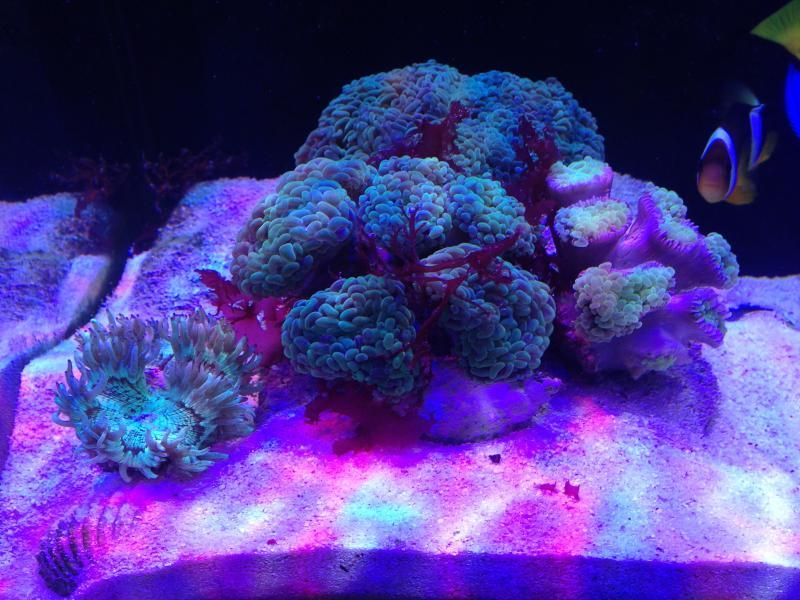
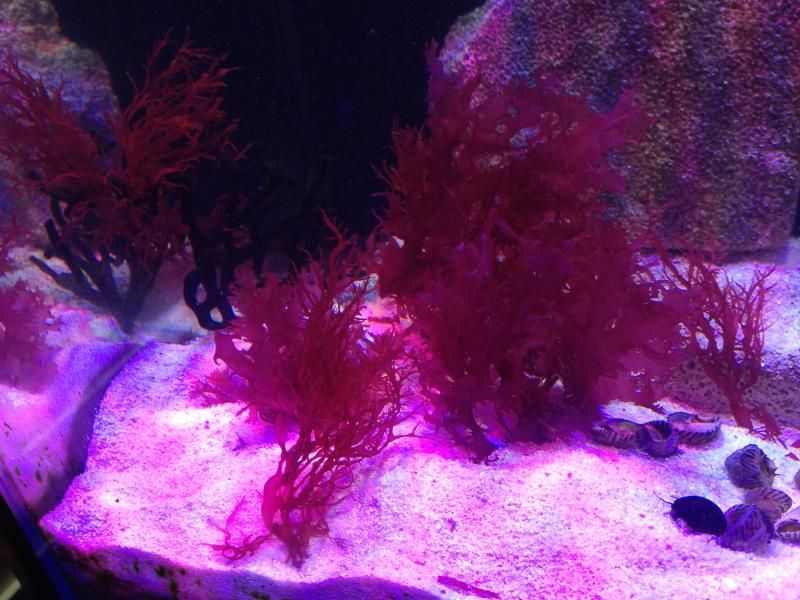
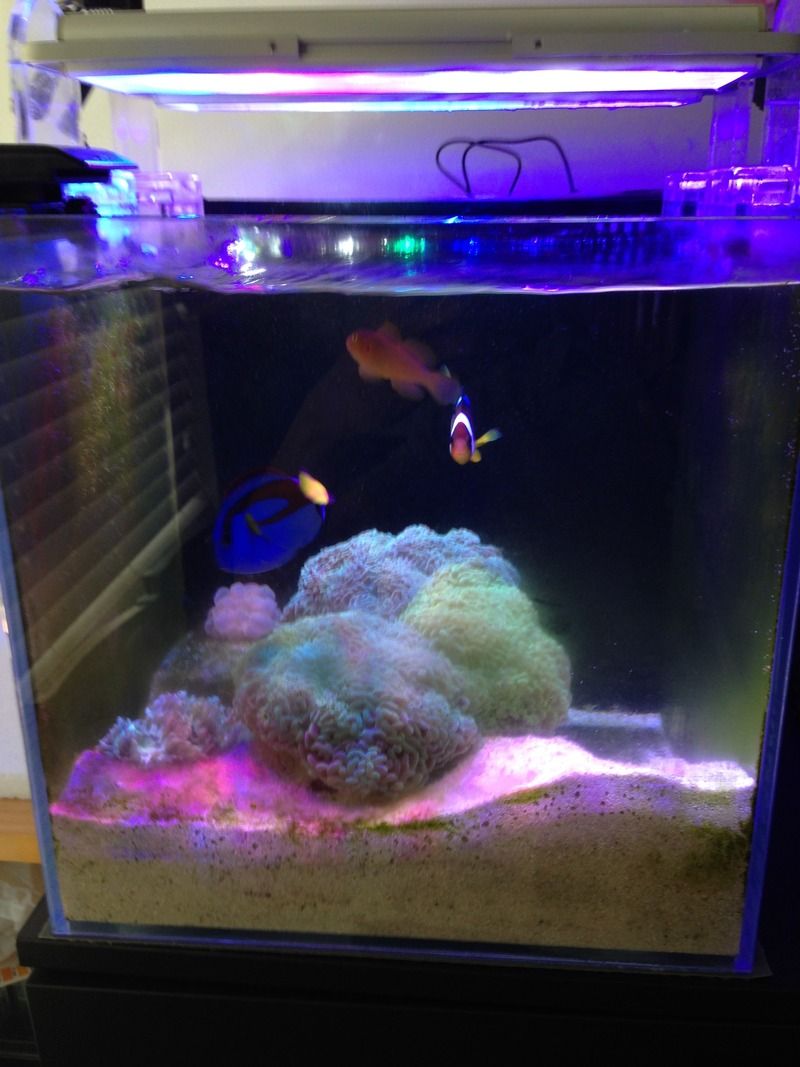
New coral additions! I miss my old scape, so decided to get similar corals. You can see my old setup here, in my Marine Pure review. As an added bonus, the corals make a good trap for the macroalgae. XD With the macroalgae stuck around the base and between the gaps between the corals, the fish don't really bother 'em. Yay!

Three Hammers (Euphyllia ancora), one green (front left), one mint (back), one yellow (front right). A small Elegance (Catalaphyllia jardinei). Both species I've had before and thrived in the previous tank. I missed them, but wanted more colors of Hammers, so decided to get a number of individuals, rather than one large one. Still hoping for a fluoro-toxic morph Hammer and a normal, brownish Hammer to add to the collection.


Also have a Sinuous Bubble Coral (Plerogyra sinuosa) that will get its own setup, when I... set it up. >_> For now, it sits behind the hammers. Super cute though. Also if you ever find these shipped to you and it looks like it is just a skeleton, don't fret. That was how this guy came to the store where I worked (I was skeptical, but my colleague said it was fine). Turns out, it is. XD Got it home, placed it into the tank, later that day it came out fully. :)


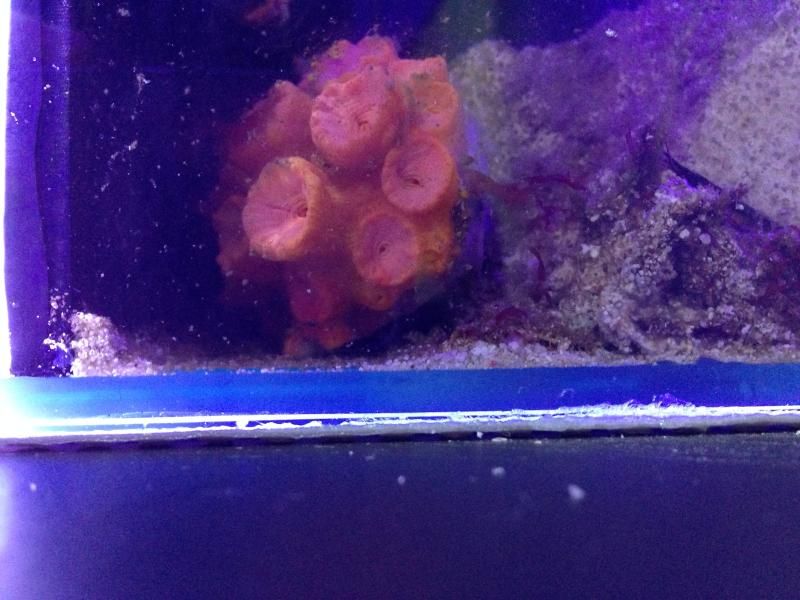
My Sunflower Coral. Poor guy is relegated to the sump. :P

And finally, this is my little experimentation. Not sure if it would work or not, but Sunflower Corals (Tubastrea spp.) are non-photosynethic corals, and do not require light for growth. So I decided to place it in the back in darkness, to see what it can do there. That is where a lot of detritus flows through, so who knows, it might be a good biological filter media. Just an experiment though.

As for acclimatization and all that, I actually didn't do any. I just took the corals out of their bags and plopped them in. :P I personally don't really bother with acclimatization, especially with healthy live stock. I find they don't really care either way.

The Hammers were a bit dreary in the store, as we had a chiller failure and temperatures got into the 30s, but they seem to be doing alright.

Heat was an issue for me before, so yesterday whilst I was at it, I did purchase a cooling fan. Haven't set it up yet as temperatures aren't too bad at the moment, but will see.

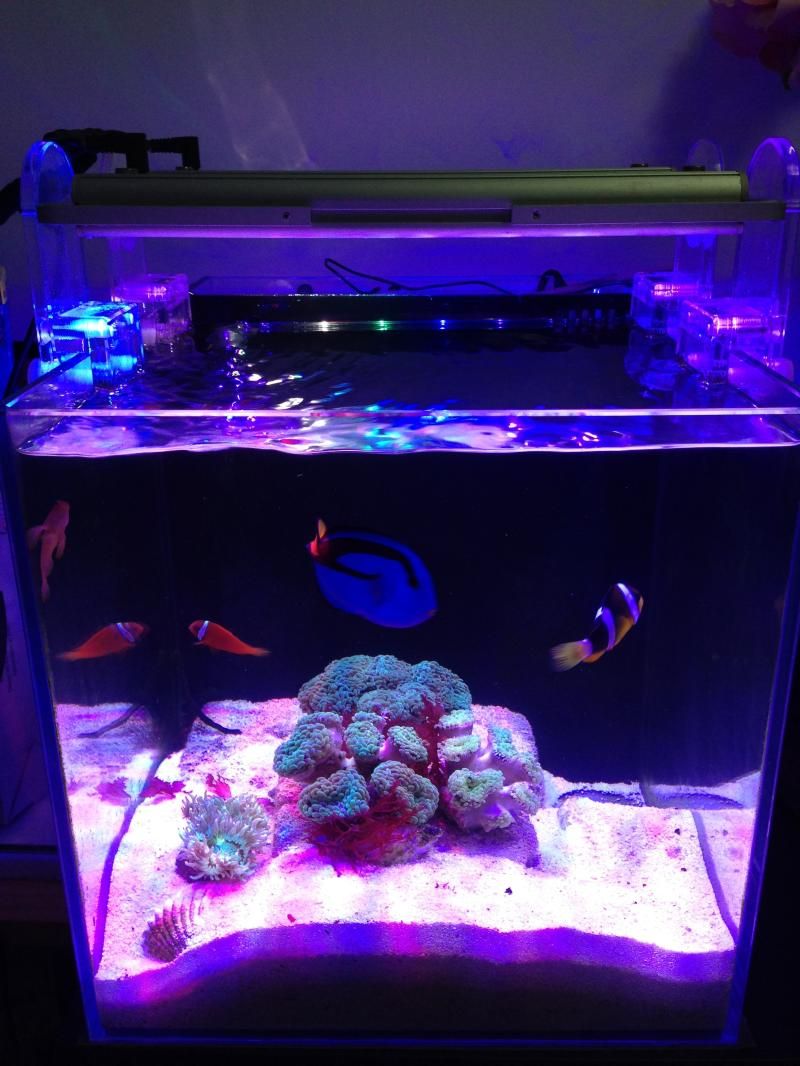
That's basically all for today. Before I go though, here's a full tank shot. :)


See you guys next time! :D

Sunday, February 22, 2015

TJ: Mini-Sea: #8

Aquarium Status

Day 36

Hey all! So it has been a few days (almost a month actually haha... >_<") since my last tank journal.

As you guys would have known from my last update, I injured myself (ahahaha...). Turned out, it was worse than I initially believed. After two weeks, I came back to my doctor and he found that I actually had a fractured scaphoid (a small bone in the wrist area).

Hence...
It's not that bad! Okay it is bad...

Aha. Aha. T_T

So I haven't really been able to get around much, a.k.a. getting corals.

Instead, I actually got some really nice macroalgae!


Oh and snails too.

So that was about a week ago.


Here's the current shot of the same area:


Is that a snail I see to the right? Was it there since last week?

What happened? Tang happened. The Regal Tang pulled out all the macroalgae. And the Clowns decided to help out as well.

So what happened to all the macroalgae you may ask?

Good question.

Let's see.

Pictures of the three corners of the tank. My macroalgae! :( They're all torn up. :(

Yep, they've been pushed to all the back corners (except the top left where the return is). :(

The glacilaria from previously died off as well. These macroalgae probably won't make it either, so I'm definitely just gonna go for corals as the main sessile organisms. Until I can get more resilient macroalgae.

That's all for today. :) Planning to go to my LFS this Thursday, so there should be a coral update then! :D

Friday, February 20, 2015

How to Know Your Aquarium has Cycled

Introduction

This is just going to be a short post, but there's so much confusion about this specific point in your aquarium's life, that it deserves a post all to itself.

So the point in time that you determine your cycle is finished is probably one of the most important points, as that is when you can add live stock. Get it wrong, and everything you add may die!

Of course, we don't want that.

So let's talk a bit about the cycle - the initial one anyways.

The initial cycle is where you are aiming to propagate enough microbes to deal with your eventual bioload.

So that also means that the initial cycle is complete, when you have enough microbes (in conjunction with all your other filter media) to deal with your aquarium's filtrative requirements.

Knowing When It is Done

Well simply enough, to know if you have enough microbes to deal with the eventual microbes, test your aquarium to see if it can deal with the eventual bioload.

All organic matter added to your aquarium will either be consumed and incorporated into organisms, be excreted, and/or be released into the atmosphere.

This means that there is a balance, and that there is no such thing as some fish releasing more waste than others (well yes some do, but that's just based on how efficiently they metabolize food and/or consume it). This means that whatever amount of food you add, that is the amount you have to deal with.

So to therefore test your filtrative capacity, simply add in the same amount of food you plan to feed.

Of course, food tend to be broken down by fish and stuff, so it is best if you break up your food as much as possible, to stimulate this.

If, by the next feeding cycle you test your water and parameters are in check, then your aquarium is cycled!

For example, if you plan to have two fish and feed them 20 pellets per day, you would test your aquarium by adding 20 pellets (smashed to pieces), and test your parameters the next day. If the parameters, such as ammonia and nitrite is zero and stuff, then you are sweet!

Depending on your filtration setup, nitrate and phosphate may not be zero - this is especially true if you rely heavily on water changes. But if you don't, you know you need some other method to reduce these.

And... that's all! Simple step to know.

If parameters aren't in check, then you know you need to grow more microbes. If there just not seem to be enough for your planned bioload, then you'll need to do something more - maybe add more filter media, or the likes.

Conclusion

To sum it all up:
-Add food as if you are feeding your live stock.
-If parameters are in check by the next intended feeding, you are sweet.
-If not, improve your filtration capacity.

Of course, always remember to separate myths from facts and know what is needed and not needed during a cycle.

Thursday, January 29, 2015

TJ: Mini-Sea: #7

Aquarium Status

Day 9

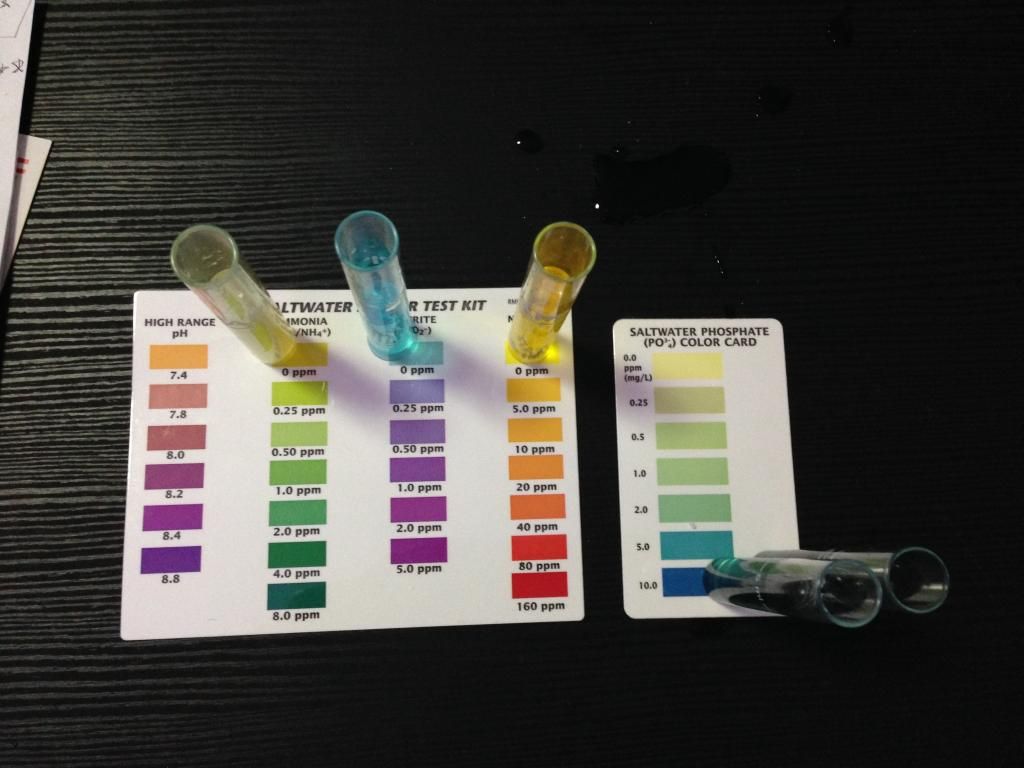
Tested my water today. Here are the results:


Test results on 27/01/2015, approximately 12 hours after addition of fish food.

Ammonia:0ppm
Nitrite:0ppm
Nitrate:0ppm
Phosphate: 10-20ppm
pH:8
kH: 9
Calcium: 620ppm

Yep, ANN zeroed out quickly post-feeding, though phosphates is off-the-charts again. Also excuse the bad picture quality, I had to take the picture quickly since I spilled the nitrites test (hence the liquid towards the top of the picture). >_<"

In hindsight I could probably have just mopped it up first.

Anyways, so this is where the microbe propagation phase has been completed. It means that in conjunction with everything else, there is enough microbe to quickly take care of any organics that is added, at least in terms of ANN.

Anyways, this does mean that it is ready for fish, though not quite for corals.

So I did a huge water change (roughly 90%).

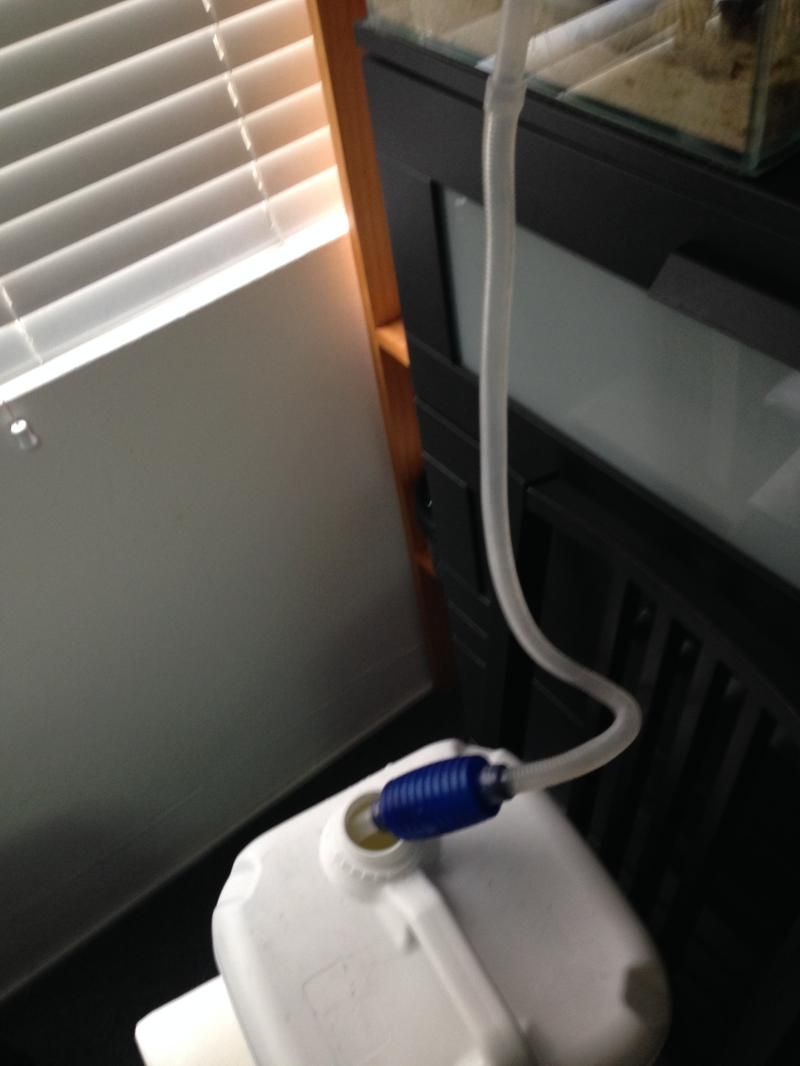
Emptied as much as possible into a 20 litre drum I have.


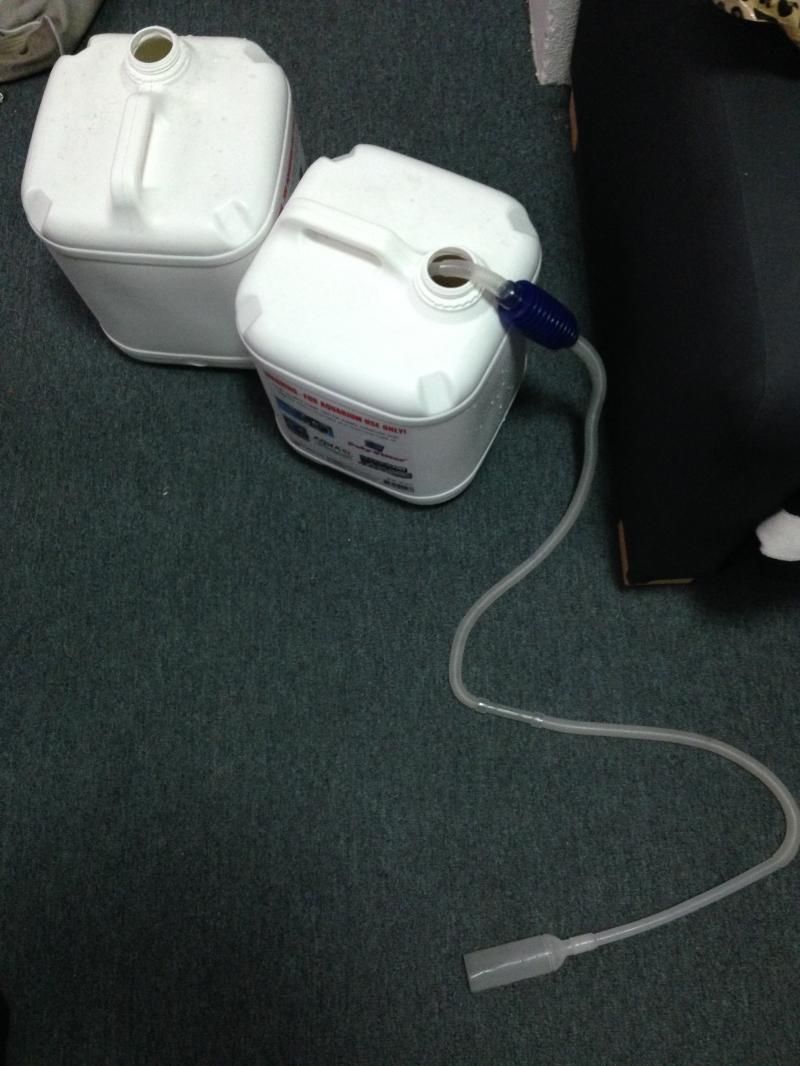
This is normally my RO drum, but at that moment it was empty, so I used it for the water change.

And then well, I had another filled with saltwater, which I then proceeded to refill the tank with.


Usually one of the drums is for salt water, the other for fresh. Here is displayed a very simple apparatus as well, for water drainage. Bought it off ebay for like $3. Been using it for 3 years.

It is always good to have two containers to do water changes. Nobody is ever the best estimators, and well, at least for me, I can never seem to estimate the amount I am changing out and in right. This ensures that a.) you are changing the same amount and b.) if you happen to not have enough water to add due to miscalculations, that you are not panicking and finding a source of saltwater half-way through a water change.

After the water change, I did test phosphates, because that was what I was most worried about. The result was at 1-2ppm, which made sense, since I did change roughly 90% of the water. Of course this is still high for corals, but for fish that is fine.

And so the plan would be to re-stock the tank the next day.

Day 10

It was raining, though I did have a chance to go to the beach. Of course, I just had to fall down and sprain my tendons in my wrist on the same day.

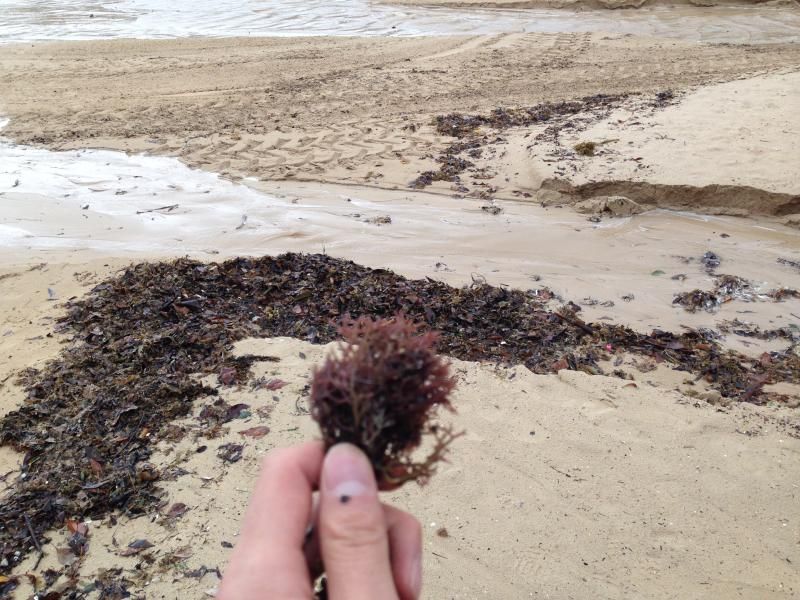
Came to the beach and managed to spot a single nice piece of red macroalgae (same species as what I already have. It seems like it is rare for this to be washed up on shore though. The picture below shows the amount of macroalgae washed up, and I only found one piece.

Maybe it is rare. Or maybe it is uncommon for it to still have color when it is washed up. Or maybe it doesn't break off as easily as everything else (I doubt it though). Whatever the case, there are so much algae there, but nothing that I definitely want. I may take a picture of a few for IDs, but I really do not want anything else in my aquarium except for this, or other red macroalgae species. Don't even want a chance that something else spreads.


A gem amongst all that.

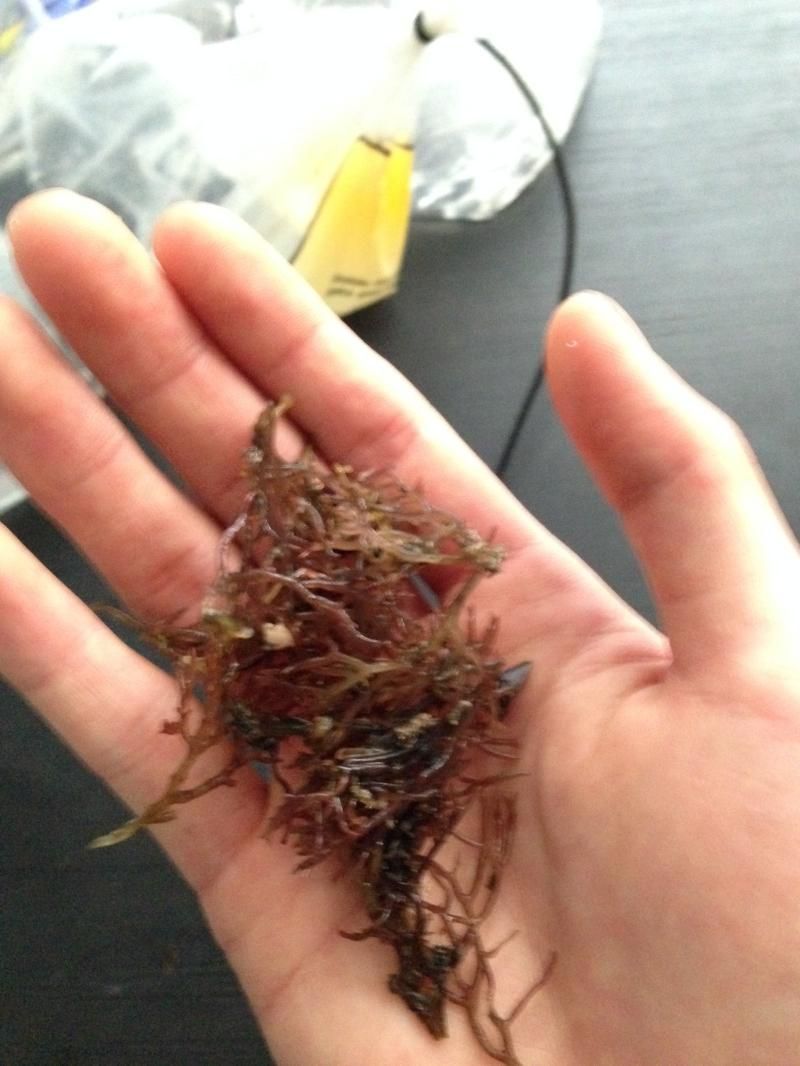
Of course, I had to fall down (again) and smash it all. :(

Here is what it looks like at home:


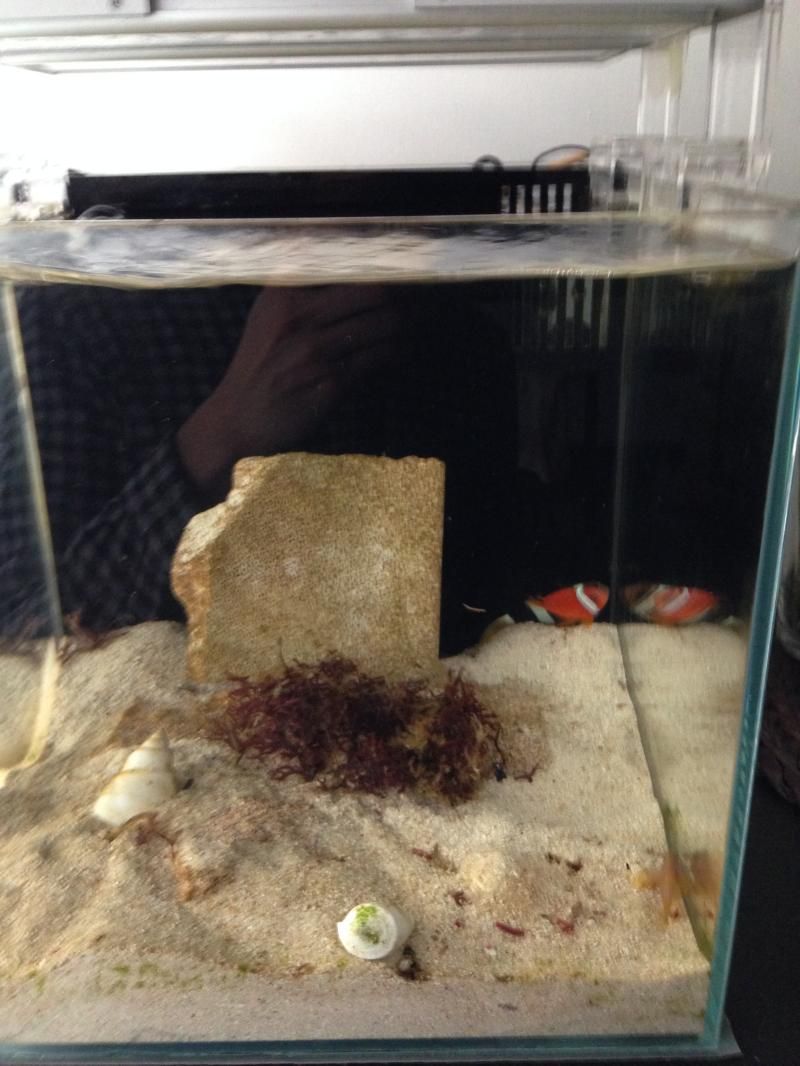
Being tiny bits and pieces, I chucked it all in the sump instead of the display. What a shame.

Oh and yes, the bags behind are the fish.


My babies are back! All four of them. I had to board them whilst I was on holidays.

Yes, I am fully aware that the bags are deflated and look like crap. That was the best I could do with just one uninjured hand. But hey, it was a short trip anyways.

Of course, I had to forget the fish food. Will be getting it the next time I come back.

Anyways, I added the fish to the aquarium. My acclimatization is very complicated.

Step 1: Open up bags.
Step 2: Scoop out the fish and put into water.

Okay, I don't recommend this all the time, but the number one rule of the hobby is be flexible. The fish are healthy and happy, and really the more time they are in the bags or not in the tank, the more they would just be more stressed out. In this case it is better to let them in.


Just added. Fish are panicking and stressed.


 Literally five minutes later. 'Were we sitting in bags for the last few hours? I didn't even know. I thought we've been here all the time.' says the fish, swimming around happily.

They were breathing heavy initially, but very quickly were back to their active selves. This is very important to note - healthy fish should be active (unless they are specifically supposed to be otherwise). They should not be stuck to a corner, especially up towards the top corners of the aquarium. That is an indication that they are not happy. If they swim around doing stuff, that's great.

Day 11


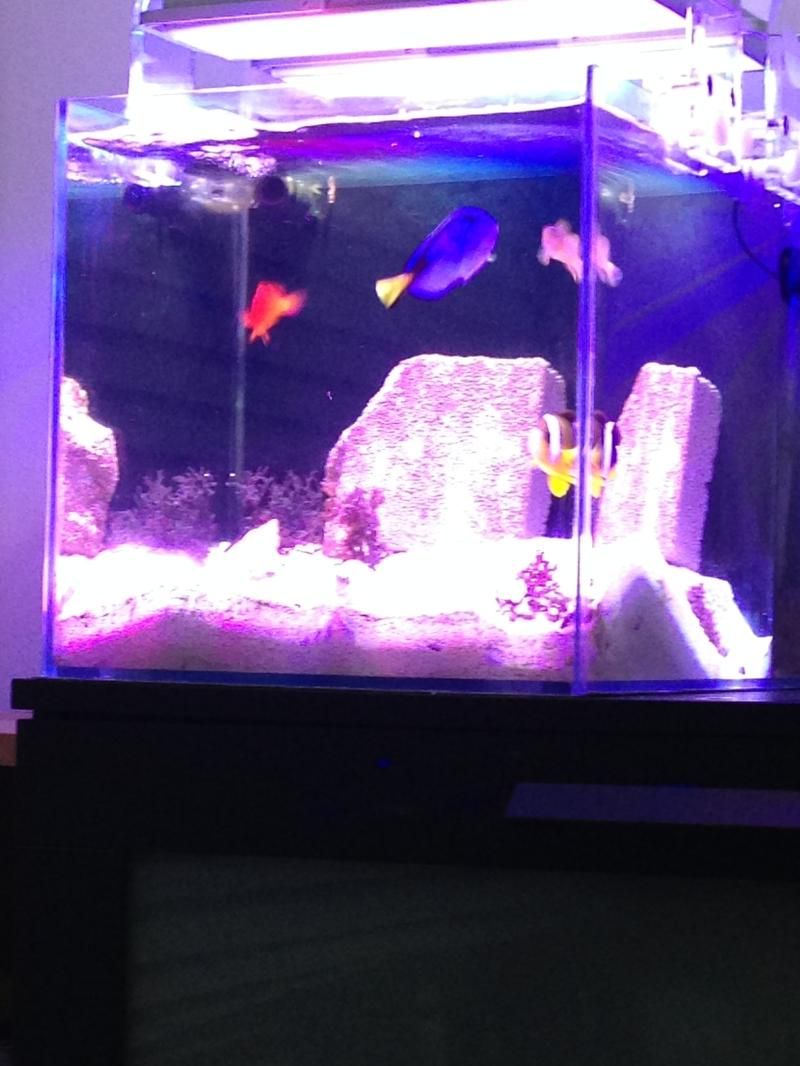
My view from where I normally sit and work.

Here is the newest view of my aquarium. As you can see, all the fish are towards the front, exploring it. Soon enough there will be corals as well for them to enjoy, but for now it is quite bare.

Interestingly enough, the Regal Tang picked at the macroalgae, eating all the dead bits and pieces (or well, the parts covered in green) leaving just the red behind. So the macroalgae now also looks a lot better.

They are back to their usual antics, digging pits in the sand and all that. :) In fact, they are so active that it is impossible to take any clear picture of them! Oh believe me, I tried. Many, many, many times.

JUST A WARNING!

By the way, one big thing that I should mention. Whenever you read tank journals, such as mine for example, be aware of everything before copying what I do, as although I - and practically anyone else - would strive to provide heaps of information in tank journals, tank journals are just that - journals, and the information is whatever we like to provide.

For example here, please do not think that you can keep a Regal Tang in this size tank forever. Regal Tangs grow very large, and in this aquarium it is a temporary resident. I am either getting a bigger tank for it, or will move it on when it grows bigger, maybe in as short of a time period as a few months. A few weeks even, if it grows bigger that fast.

This could have been something I keep in my head rather than writing it out, so with anything, make sure you understand why such things work before attempting it.

Cheers!